
Green IT
The importance of sustainable digitalisation
Information technology is without question a groundbreaking achievement of human evolution. At no other time in history could data, information, goods and services be sent around the globe as quickly and independently as they can today. The ongoing development towards even more powerful hardware and software solutions continues to fuel this trend, and there is no end in sight. However, there is no doubt that this development also has its downsides. As digital transformation progresses, the environmental impact of IT infrastructures continues to grow. The call for sustainability in IT is here. Green IT is intended to offer solutions!
Table of contents
What does Green IT mean?
Green IT, short for “environmentally friendly information technology”, refers to the use of environmentally friendly products, services, technologies and practices in IT in order to increase energy efficiency, minimise environmental impact and support sustainable solutions for information technology. The focus is on the entire life cycle: from manufacture and use through to disposal.
Why is Green IT so important ?
Our growing consumption has demonstrably negative consequences. This is symbolised by Earth Overshoot Day. This year it was reached as early as 2 August. With every additional day, the deficit grows. In other words, we emit more CO₂, consume more energy and more natural resources than the Earth can cope with. The effects of climate change, and the discussions about them in large parts of society, politics and business, are increasingly putting pressure on every individual to act sustainably.
As transformation increases, IT is also coming more and more into focus when it comes to the responsibility to implement Green IT measures! The environmental impact of IT products is complex and depends on the type of product, how it is manufactured and how it is used. In general, however, the burden caused by IT products is high: the manufacture of hardware components such as processors, memory chips and screens alone requires considerable resources, including rare earths, metals and large amounts of energy. The use of IT products, as is the case with servers and data centres, can also involve enormous energy requirements. According to experts, electricity consumption in data centres, for example, is expected to increase by more than 60 percent between 2015 and 2025. The disposal of IT products also poses a serious environmental problem, and special waste disposal methods are needed to get the growing amount of electronic waste under control.
Information technology: problem and solution at the same time!
Green IT (environmentally friendly information technology) has the strategic goal of minimising the environmental impact caused by information technology. However, IT is not only the trigger of this growing problem, it can also be key to solving it: a successful shift towards a climate-neutral and sustainable economy and society is hardly possible without the integration of digitalisation.
Here is a selection of examples of how Green IT makes an important contribution
- Reducing energy consumption through energy-efficient hardware and software
- Reducing CO₂ emissions, such as those generated by the operation of IT equipment and data centres, e.g. through the use of renewable energies and efficiency measures
- Promoting resource efficiency in the manufacture and recycling of IT products
- Extending service life by developing durable IT devices and promoting repair and upgrade options
What problems do SMEs face when switching to sustainable IT?
When implementing Green IT measures, small and medium-sized enterprises often reach their limits, usually due to a lack of expertise. For these companies, information technology is not the core of their business, but merely serves as a „means to an end“ that has to be operated on the side. They are also often hesitant about initial investments or fear that implementation in their existing system could be problematic. It is true that the introduction of “green IT solutions” is far-reaching and affects all areas of a company, which is why measures cannot simply be taken on the side and „in passing“.
Regardless of their size, however, companies will ultimately not be able to avoid Green IT measures. Pressure from society and politics will increase. The big tech companies, which are responsible for rolling out technical and security-related updates, are already feeling this. After all, they often still decide when mobile phones and PCs have to be retired, even if they are still technically usable. Proactive IT service providers can help small and medium-sized enterprises build sustainable IT systems. There are many ways to promote change and awareness of Green IT, even through small steps.
What measures can small and medium-sized enterprises implement?
The expression “small steps – big impact” fits quite well here. Below, we have compiled a selection of measures ranging from simple, small steps to comprehensive, professional initiatives to contribute to sustainability in companies.
Short-term Green IT measures
- Paperless office
An office without paper – that is, of course, the ultimate goal! Does everything really always have to be printed out? If your answer to this question for your company is „yes and no“, then you should at least make sure that your printer settings are set to print double-sided. That may not save ink, but it does at least save paper! - Use of IT products and online services that support sustainable projects
The important thing here is that the sustainability projects make a long-term contribution and are not just pure marketing claims! - Power options in the control panel
Choosing the right power option depends on the user’s needs. Does it have to be high-performance mode, or is power-saving mode perhaps sufficient? This decision also depends on the performance required of the PC. Operating systems also provide additional power settings. These allow fixed sleep or shutdown times to be set up. Modern PCs have Wake-on-LAN technology. This can be used here as well. But be careful – for security reasons, this technology should only be configured by an IT professional or your IT service provider. - Upgrades can extend the service life
The term “upgrade” has a specific meaning in information technology and refers to the fundamental change to a higher-value version. This term is often confused with “update”, which usually describes minor technical or security-related updates that are in most cases provided free of charge. Upgrades of various components such as processors, hard drives, graphics, sound and network cards serve to increase the performance and speed of a system. This enables an older device to continue running current software and other applications efficiently. At the same time, an upgrade helps conserve resources, as only certain parts need to be replaced rather than the entire device. Updates are also important for adapting a system to relevant changes. Proactive IT support keeps a close eye on both areas through regular maintenance.
Medium-term Green IT measures
- Environmentally friendly hardware
The pressure to produce more sustainable IT products has increased in recent years. Manufacturers are aware that competitors, politicians, investors, shareholders and, not least, consumers themselves are demanding sustainability strategies from them. The large IT companies have therefore set themselves sustainability targets with regard to their ecological footprint, which also include the manufacture of environmentally friendly hardware. - Use of multifunction devices
Copying, scanning and printing in one device – using multifunction devices is in any case more environmentally friendly than providing a separate device for each function. There are also environmental labels that assess precisely these multifunction devices in terms of their energy consumption, fine dust and pollutant emissions, and that also require social and ecological conditions to be met across the entire supply chain. - Recycling or refurbishing
These measures are of course also possible in the short term and always apply when IT products have ostensibly reached the end of their service life. As the service life of PCs, for example, is currently around five years, we have classified this measure as medium-term. Electronic waste is a huge problem. On the one hand, IT products are made up of a large number of different, sometimes toxic, materials. On the other hand, some components are difficult to recycle. It is therefore important to hand over electronic waste to professional recycling centres. Only controlled, managed disposal makes environmentally compatible recycling possible. With the introduction of the German Electrical and Electronic Equipment Act, legislators also aim to prevent electronic waste from being disposed of improperly or in household waste. Refurbishing is a term used to describe the reconditioning of electronic devices such as PCs, smartphones or tablets in order to give them a new life, for example as B-grade goods. One aim of refurbishing is therefore to counteract the growing consumption of new devices. Non-governmental organisations and other initiatives have specialised in refurbishing and use the reconditioned products in the form of donation programmes for social institutions.
Long-term Green IT measures
- Cloud computing
This term generally refers to the provision of a wide range of IT services over the internet (e.g. server resources, storage capacity, databases, networks and much more) and not just the provision of websites alone (cloud hosting). Whether cloud computing can be considered more environmentally friendly depends on many factors, e.g. which energy sources and resource efficiency measures the respective data centre uses. However, cloud providers undoubtedly have different options for optimising the hardware performance of servers than a single physical company server does. Another huge advantage is that companies can scale their requirements. - Use of terminal servers
A terminal server, also known as a remote desktop server, is a computer or server that uses special software to allow multiple users to access company data and applications simultaneously. The server environment is made available to each user according to individual sharing settings. A significant advantage is that scalability is possible, for example in terms of the performance required or the number of users. Other advantages offered by terminal servers are the reduction of hardware and software costs and a technical solution for enabling employees to work from home. Users can also work on older and less powerful devices, as long as the applications are delivered via a powerful terminal server.
How do Computer-Spezialisten approach Green IT?
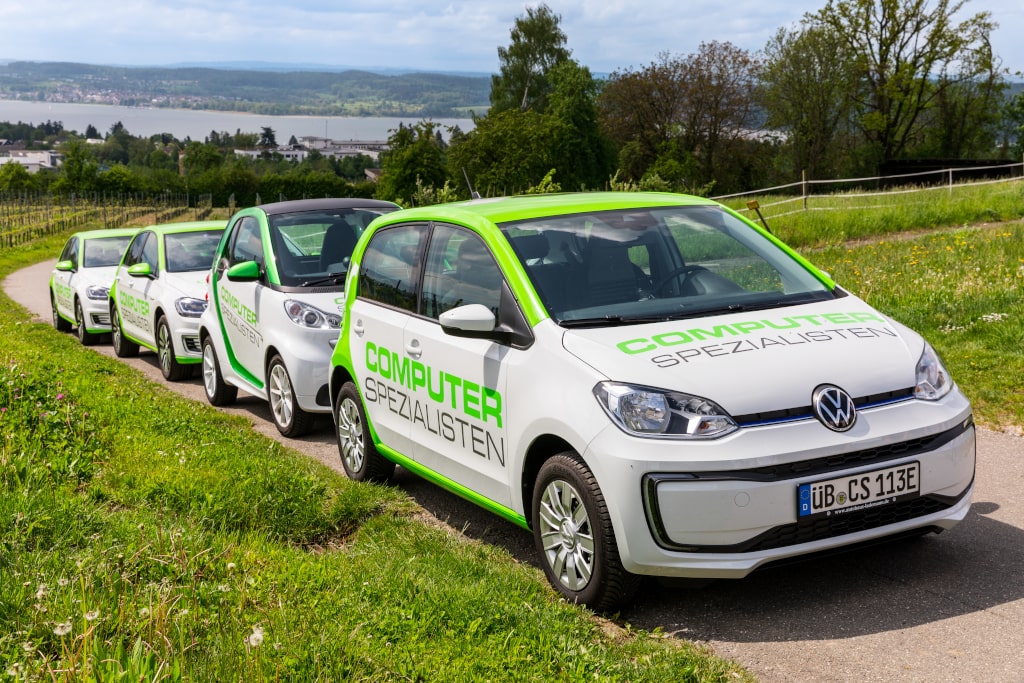
We, too, are actively committed to conserving resources. As an IT service provider, we have a considerable electricity requirement, which is why we have been operating a photovoltaic system since 2016 that feeds surplus electricity into the grid. In addition, we source the rest of our electricity exclusively as green electricity. Our first electric car was purchased 10 years ago. The company fleet now consists of five fully electric vehicles, which are available to our employees for customer appointments. All colleagues can also use e-bikes, both in their free time and for commuting to work.
Energy-saving and durable products
As part of our IT sales, we attach great importance to offering our customers high-quality products that are particularly energy-saving and durable. One example of this is PCs that not only achieve the usual minimum service lives but, ideally, can even exceed them.
Proactively identifying and eliminating vulnerabilities
In order to identify and resolve vulnerabilities in the system in good time, e.g. through possible upgrades, our customers receive monitoring and maintenance services for their existing systems at fixed, agreed prices with our IT service flat rates.
Refurbishing also plays a role for us, on a smaller scale. Whenever our trainees have time, they take care of our old devices – a sustainable learning programme, so to speak!
Conclusion
Business, society and politics all share a responsibility to make the world worth living in for future generations and to maintain a balance between economic efficiency, social justice and ecological stability. The internet, with all its possible uses, is here to stay, and digitalisation will continue to develop dynamically and with new innovations. All stakeholders should recognise these changes early, shape them in an environmentally friendly way and make intensive use of the opportunities for environmental protection. Companies that have recognised the value of future-oriented IT, including Green IT, as a competitive advantage and image factor will be successful in the long term.